
I thought trading was gambling. Then it clicked.
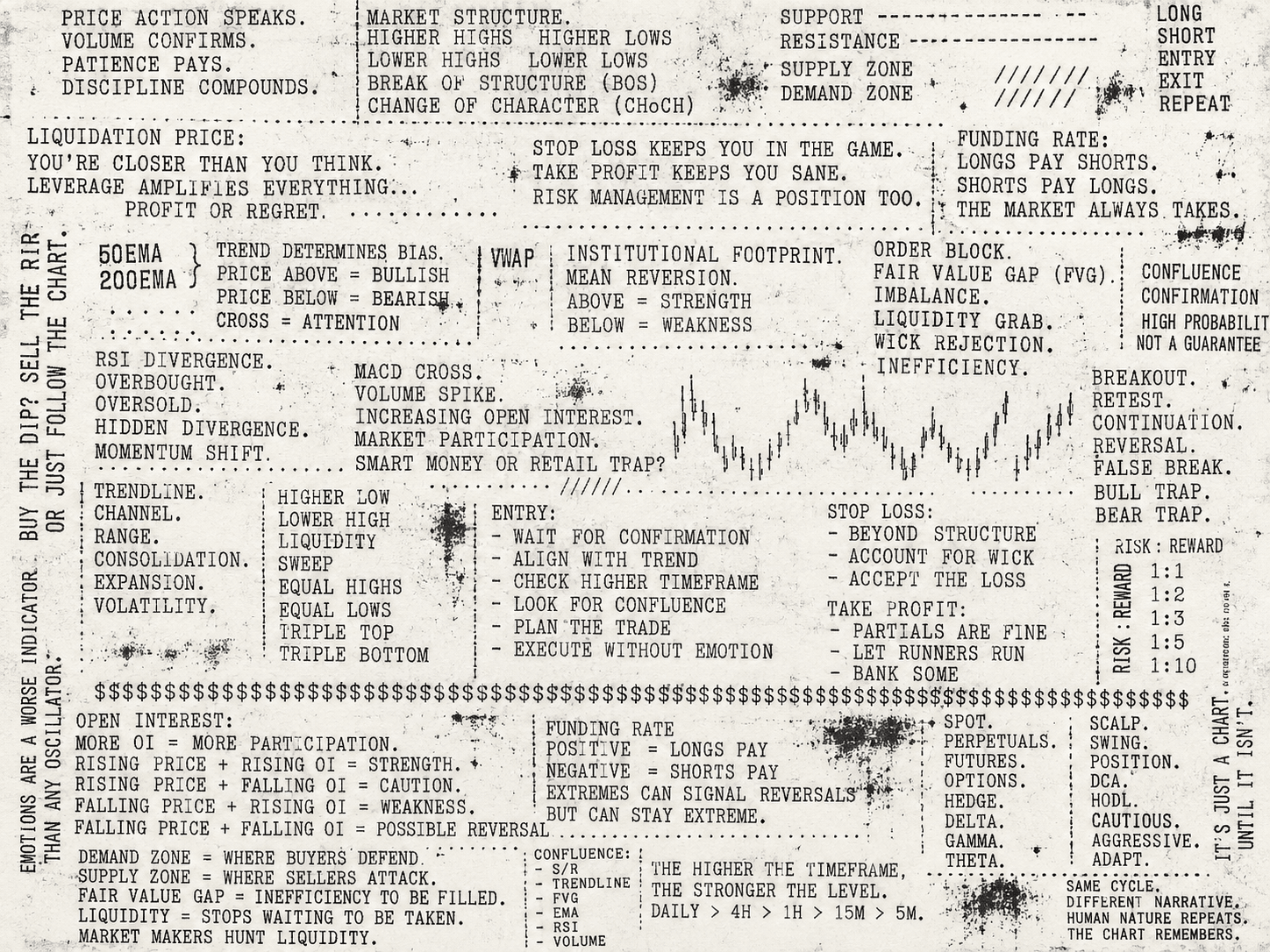
I recently got myself into crypto perp trading.
It’s something I never really saw myself doing. But after a season of trading part-time, I’ve been surprised by how much I actually enjoy it. Not in a “this is easy money” kind of way. More like: this is difficult, fast, psychological, brutally honest, and strangely amusing.
So I’m planning to take it more seriously from here. Spend more energy learning from veterans, trading communities, and people who have survived enough cycles to know what they’re talking about.
You might be thinking what I was thinking:
Isn’t that just pure gambling?
Fair question.
Here’s a bit of context.
When I left Perp Labs in May, I spent about a week reflecting on my career so far, assessing my portfolio, figuring out what needed to be updated, and also looking properly at my crypto investment portfolio.
That was when I got rudely awakened by a reality I didn’t really want to face:
I don’t know shit about investing in crypto.
For the longest time, I carried over the same long-term investing mindset I had from buying the S&P 500 index. In crypto Twitter terms, I was basically a so-called diamond hand. Hold through volatility. Don’t touch anything. Wait for the next cycle.
Except this mindset had me round-trip my profit and sit 50% down after the 10/10 bloodbath last year.
This is my first proper crypto cycle, and looking back, I made a pretty obvious mistake: I was too greedy. I wanted to flip my assets into a few X, and I convinced myself that holding through everything was the “high conviction” thing to do.
It has been a brutal and painful way to learn the lesson.
For a while, I was still a delusional bull after that horrendous event. I kept holding my spot positions, telling myself I had seen this before during the COVID crash and came out fine. Surely I could ride this into the next cycle.
Pure COPIUM.
What I didn’t understand was that I had already gone far beyond my actual risk tolerance. I had around 80% of my assets in crypto, and the unrealised loss was no longer just a number on a screen. It had started affecting my mental health.
That was the part I couldn’t ignore anymore.
I realised I had to stop out a major portion of the positions in my portfolio and properly learn the fundamentals of investing, risk, and asset management. Not just “buy good coins and wait.” Actually manage my assets like I’m responsible for a company.
Because I am.
Once I dove deeper into the trading and investing world, I realised my past impression of seeing perps as pure gambling was also a kind of misjudgement. I had been dangerously assuming that holding spot was automatically safer and more responsible, when the thing that actually matters is risk and size management.
That changed how I look at leverage: perps don’t automatically mean I’m going to get rekt; used properly, they are a way to give a small size of funds more exposure to a trade I think has asymmetric upside, with the risk already calculated before I enter.
If I don’t learn how to manage money properly, my money insecurity will cost me even more in the near future. Not just financially, but mentally too.
So I stopped being a delusional diamond hand and started learning how to read charts, data, positioning, and market behaviour.
I read books like Jesse Livermore’s memoir. I studied strategies and mindset material from trading firms. I joined a few trading communities. I started paying attention to how good traders think, not just what trades they take.
Then I applied what I learned to actual trades.
I use Hyperliquid to trade, and TradesRecord’s freemium plan to review my performance. The review part is important, because without it, trading can easily become just another emotional loop. You win, you feel smart. You lose, you feel stupid. But when you track the trades properly, patterns start to show up: what setups work, where I get impatient, when I size too big, and how often I break my own rules.
More importantly, I’ve learned fast by playing the actual game, with my own money on the line.
And I have to say: I enjoy the process quite a lot.
Not because winning feels good, although obviously it does. But because the feedback loop is clean. You make a thesis. You define your risk. You enter. The market responds. You are either right, wrong, early, late, oversized, impatient, or lucky.
There is nowhere to hide.
I’ve been thinking about why trading kind of clicks with me. There must be elements in it that align with how my brain already works.
My self-analysis so far is this: it’s the pattern recognition, the psychology, and the constant reading of human behaviour.
All of these were heavily developed while working as a product designer and UX engineer. You spend years learning how people behave, what they say versus what they actually do, how emotions drive decisions, how systems create incentives, and how small signals reveal bigger truths.
My startup experience also makes the fast validation loop feel natural. In product, you build, test, learn, adjust. In trading, you form a thesis, take a position, manage risk, and get feedback from the market quickly. Different game, similar muscles.
Of course, trading is not product design. The market doesn’t care about your taste, your effort, your story, or how convinced you are. It only cares about price.
But that’s also what makes it interesting.
It forces honesty.
There’s a saying that every experience you’ve had so far will not be wasted. You just haven’t seen how it all connects yet.
That deeply resonates with me.
Maybe this is one of those moments where things start to connect.